Trainer-Led Enrichment Sessions
Resident Only Service
Exercise the body. Engage the mind. Support the whole dog.
A 45-minute structured enrichment session designed to provide your dog with purposeful physical activity, mental engagement, sensory exploration, and appropriate guidance.
$45 per session
Trainer-Led Enrichment
Each session is guided by K9 Justice's understanding of canine behavior, communication, and individual needs, with appropriate structure and guidance throughout the experience.
Potential Benefits May Include
Clear Communication
Dogs are constantly communicating with us through their body language, behavior, and responses to the world around them. Trainer-led enrichment gives your dog an opportunity to work with someone who understands those signals and knows how to respond appropriately.
The goal is not simply to ask the dog to listen, but to listen to the dog as well.
Confidence & Exploration
For some dogs, appropriate exploration and positive experiences in their environment may help build confidence, particularly when they're naturally cautious or uncertain.
A Healthy Outlet for Energy
Physical activity provides an opportunity to put pent-up energy to productive use rather than carrying that excess energy back into the home.
Mental Engagement
Sniffing, investigating, making choices, and responding to their environment give your dog opportunities to use more than just their muscles.
Decompression
A purposeful outing followed by appropriate downtime can give your dog an opportunity to settle and recover. You may simply find that your dog comes home ready for a nice, well-earned nap.
A Positive Relationship With Their Handler
Consistent, thoughtful handling gives your dog an opportunity to learn that working with their handler can be predictable, safe, and rewarding.
Every dog is different. Potential benefits vary by individual dog, and each session is adapted to the dog's needs, comfort, and responses.
Is This Right for Your Dog?
Trainer-led enrichment may be a good fit for owners who want to provide their dog with more purposeful physical activity, mental engagement, and environmental exploration than a conventional walk.
Before accepting a dog, K9 Justice requires an intake process to learn about the dog's:
Health and physical limitations
Behavioral history
Triggers and sensitivities
Leash behavior
History of aggression or biting
Dog-to-dog interactions
Escape or flight behavior
Handling considerations
Anything else that may affect safety or the dog's welfare
Submitting an intake does not guarantee acceptance.
Each request is reviewed to determine whether the service is an appropriate fit.
Some dogs may benefit from an individualized training consultation before participating in enrichment sessions.
To maintain the quality and individualized attention of each session, this service is intentionally limited.
Once those spots are filled, additional residents may join the waitlist.
Additional availability may open seasonally, based on weather, demand, and scheduling.
More Than a Walk
A walk doesn't have to be simply about covering distance.
Dogs benefit from opportunities to move, explore, sniff, investigate, and engage with their environment. These sessions combine physical exercise with mental and sensory engagement to create a more purposeful experience for your dog.
The goal isn't simply to make your dog tired.
The goal is to provide meaningful physical, mental, and sensory engagement.
Every Dog is Different
No two dogs experience the world in exactly the same way.
Age, physical ability, temperament, environment, previous experiences, and individual preferences can all influence how a dog responds to an activity.
The session is adapted to the dog—not the other way around.
What Is Enrichment?
Enrichment is more than keeping a dog occupied. It can contribute to a dog's overall welfare by providing opportunities for physical activity, exploration, sensory engagement, choice, and interaction with their environment.
Dogs have behavioral and sensory needs that go beyond simply being exercised. Providing appropriate opportunities to explore and engage with their surroundings can support positive behavioral outcomes like calm behavior and contribute to a more enriching daily experience.
That's why we look beyond simply making a dog tired. We consider the whole dog.
-
For healthy dogs without medical or physical limitations, opportunities for varied movement—including walking and trotting—can help support appropriate physical activity and conditioning. Exercise intensity is adjusted to the individual dog's age, fitness, health, and physical capabilities.
-
Dogs don't just need opportunities to move their bodies. They also benefit from opportunities to investigate, make choices, and engage with their surroundings.
-
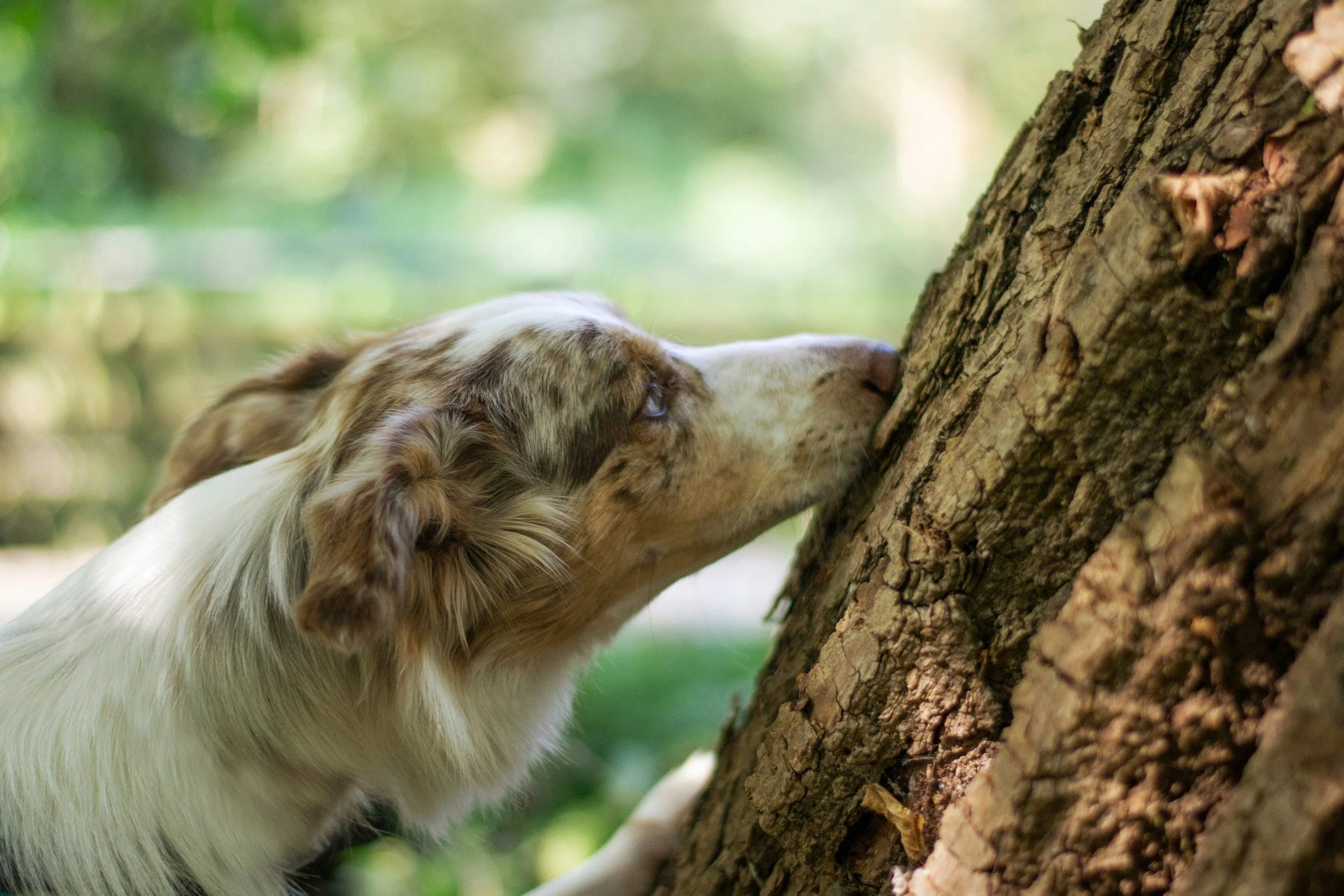
Let them use their nose.
For dogs, scent is an essential part of how they experience and investigate the world.
Sniffing is also a natural, species-typical behavior for dogs. Providing appropriate opportunities to sniff and investigate allows dogs to express this natural behavior while gathering information about their environment. In an enrichment context, these opportunities can support behavioral welfare by allowing dogs to engage in meaningful sensory exploration and express normal behavior (Duranton & Horowitz, 2019; Novack et al., 2023).
During an enrichment session, appropriate opportunities to sniff and explore are intentionally incorporated into the experience rather than treated as distractions or wasted time.
Research examining scent-based activities in dogs has identified behavioral and physiological changes associated with olfactory activities. At the same time, researchers have noted that more work is needed to fully understand how different scent activities affect canine welfare.
Enrichment isn't about simply keeping a dog moving. It's about giving them appropriate opportunities to interact with the world.
-
Enrichment doesn't mean allowing a dog to do whatever it wants.
Throughout the session, appropriate behavior and safe handling are supported through clear structure and guidance appropriate to the individual dog.
BODY | MIND | SENSES
Physical activity | Mental engagement | Sniffing & exploration
What Happens During a Session?
We Start at Home
The session begins where your dog is most comfortable—at home.
This allows for a natural transition from the home environment to the outdoors rather than simply arriving, grabbing the leash, and heading out.
We Move
Your dog receives purposeful physical activity appropriate to their age, ability, and the conditions of the day. The goal is to provide movement without simply pushing your dog toward exhaustion.
We Explore
There is time to sniff, investigate, and experience the environment.
We Engage
Your dog is given opportunities to observe, investigate, make choices, and interact appropriately with their surroundings.
Throughout the session, your dog receives clear, consistent guidance to help maintain a safe and productive experience. We work with your dog's individual needs, allowing appropriate exploration while providing structure when it's needed.
We Guide
We Decompress
The objective isn't to push your dog until they're exhausted.
A successful session provides opportunities for activity, engagement, exploration, and recovery.
Following the session (typically within 24 hours) you’ll receive a brief summary of activities, general observations, and any recommendations.
Frequently Asked Questions
-
Each session is approximately 45–60 minutes, depending on the individual dog and the conditions of the day.
-
No. Enrichment sessions combine purposeful physical activity, mental engagement, sensory exploration, and trainer-led guidance.
-
Each session is adapted to the individual dog and may include:
Purposeful physical exercise
Sniffing and environmental exploration
Mental engagement and opportunities to make choices
Threshold and controlled transitions
Impulse-control opportunities, such as pausing before moving through doors or responding appropriately to environmental distractions
Structured walking and handling
Periods of decompression and recovery
The session isn't a rigid routine. Your dog's needs, responses, and comfort help determine how the session unfolds.
-
Absolutely. Sniffing and environmental exploration are an intentional part of the enrichment experience.
-
Not necessarily. For your dog's first session, K9 Justice may ask that you be present so we can meet, review any important considerations, and establish the appropriate routine. After the initial session, arrangements can be made for your dog to participate without you being home, when appropriate.
-
Every dog must complete an intake before participating. This allows K9 Justice to determine whether the enrichment service is an appropriate and safe fit. Some dogs may be better suited for an individualized training consultation first.
-
Enrichment sessions are designed to provide physical activity, mental engagement, sensory exploration, and structured guidance. Individualized training and behavior modification are separate services.
-
This service is currently available exclusively to residents of the community and is limited to five initial client spots.
-
You can join the waitlist and will be contacted if an opening becomes available.
-
Sessions may be shortened, rescheduled, or modified when weather or environmental conditions could compromise the dog's safety or comfort.
-
Contact us via email enrichment@k9justice.com to request a spot. If the initial client spots are full, you’ll be added to the waitlist. When an opening becomes available, we’ll contact you with the next steps and intake form.
Exercise the body. Engage the mind. Support the whole dog.
Give your dog more than a walk.
Research & Welfare
At K9 Justice, enrichment is grounded in the understanding that supporting a dog's well-being involves more than physical exercise alone.
Enrichment can provide dogs with opportunities to explore, investigate, engage their senses, make choices, and perform behaviors that are meaningful to them. Research on companion-animal welfare has found that enrichment can positively influence behavioral welfare indicators, including increased exploration and behavioral variability and reductions in some stress-related behaviors.
Why Sniffing Matters
Dogs experience their environment through an exceptionally developed sense of smell. Sniffing is also a natural, species-typical behavior that allows dogs to investigate and gather information about their environment. Providing appropriate opportunities to sniff allows dogs to express this natural behavior while engaging with one of their most important sensory abilities.
Research examining scent-based activities in dogs has identified behavioral and physiological changes associated with olfactory activities. A 2025 scoping review examined 27 studies involving shelter, working, and companion dogs. The authors found evidence of measurable behavioral and physiological responses while also emphasizing that more research is needed to fully understand the welfare effects of different scent activities.
For that reason, K9 Justice doesn't treat sniffing simply as something that slows a walk down.
Exploration is part of the experience.
A Whole-Dog Approach
Physical activity, mental engagement, sensory exploration, appropriate choice, and recovery can all play a role in creating a more enriching experience for an individual dog.
That doesn't mean every dog needs the same activities—or that every enrichment activity will affect every dog in the same way.
The session is adapted to the individual dog, with their comfort, safety, and overall welfare kept at the center of the experience.
Selected Research
Amaya, V., Paterson, M. B. A., & Phillips, C. J. C. (2020).
Effects of olfactory and auditory enrichment on the behaviour of shelter dogs.
Animals, 10(4), 581.
Duranton, C., & Horowitz, A. (2019). Let me sniff! Nosework induces positive judgment bias in pet dogs. Applied Animal Behaviour Science, 211, 61–66.
Fountain, J., Fernandez, E. J., McWhorter, T. J., & Hazel, S. J. (2025).
The value of sniffing: A scoping review of scent activities for canines.
Applied Animal Behaviour Science, 282, 106485.
Novack, L. I., Schnell-Peskin, L., Feuerbacher, E., & Fernandez, E. J. (2023). The Science and Social Validity of Companion Animal Welfare: Functionally Defined Parameters in a Multidisciplinary Field. Animals, 13(11), 1850.
This review examines animal welfare and social validity from the animal's perspective, emphasizing naturalistic behavior, choice, agency, and other welfare indicators when evaluating interventions for companion animals.